


Why England’s towns need mapping
Published in BE News on 22 September 2026
In my quarter century spent analysing Britain’s towns and cities, I am left with one unavoidable conclusion: we still don’t actually know them. For all the ministerial bluff about “place‑based growth” and the government’s current 10-year industrial strategy Invest 2035 positioning data as the fuel of future industry, England’s towns remain stubbornly unmapped in any meaningful, centralised way.
Since 2012, billions have been poured into high street and town centre funding initiatives. Yet there is still no national evidence base that allows anyone – councils, businesses, communities or Whitehall itself – to track what has worked, what hasn’t, or why.
Instead, money is repeatedly wasted on one‑off research projects that gather dust, while decision makers are left without a single source of truth about the places they are meant to be improving.
Everyone I meet – elected members, officers, BID managers, local businesses – says the same thing: they want accessible, independent, comparable data. A baseline. A way to understand their town in relation to others. The lack of a single source’ of data and insights is strangling growth and development. Scotland has it through Understanding Scottish Places, launched on 2015. England does not.
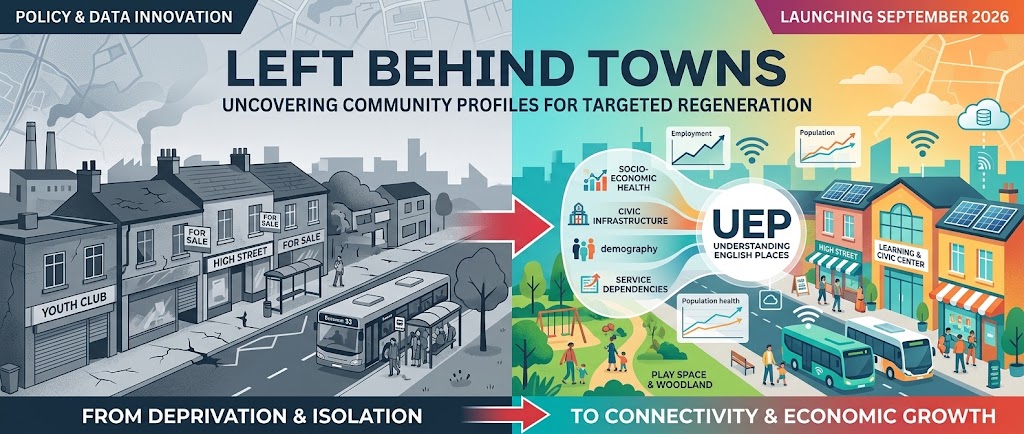
That is why we have built Understanding English Places. Based on the Scottish model and built by data and research firms Didobi and Edge Analytics, it is a starting point for more than 3,463 towns and cities to finally see themselves clearly and to act on evidence rather than instinct.
Moving beyond standard spreadsheets, UEP translates vast amounts of complex raw data into a visual ‘mirror’ of a town’s true character. Detailed within the platform’s core documentation, the model delivers critical, hyper-local insights across several key pillars such as lived local demographics and health, commercial vitality and retail diversity, housing, connectivity and community safety, and objective place benchmarking.
If Invest 2035 is serious about empowering local clusters, then giving citizens and councils the data to understand their own places is the most powerful legacy any government could leave.
As W. Edwards Deming, pioneering US economist, put it so succinctly: without data, you’re just another person with an opinion.


Leave a comment: